
 Top
Top
https://deepseanews.com/2013/11/true...hima-disaster/
POSTED ON BY KIM MARTINI
True facts about Ocean Radiation and the Fukushima Disaster
On March 11th, 2011 the Tōhoku earthquake and resulting tsunami wreaked havoc on Japan. It also resulted in the largest nuclear disaster since Chernobyl when the tsunami damaged the Fukushima Daiichi Nuclear Power Plant. Radioactive particles were released into the atmosphere and ocean, contaminating groundwater, soil and seawater which effectively closed local Japanese fisheries
Rather unfortunately, it has also led to some wild speculation on the widespread dangers of Fukushima radiation on the internet. Posts with titles like “Holy Fukushima – Radiation From Japan Is Already Killing North Americans” and ”28 Signs That The West Coast Is Being Absolutely Fried With Nuclear Radiation From Fukushima” (which Southern Fried Science has already throughly debunked ) keep popping up on my facebook feed from well-meaning friends.
I’m here to tell you that these posts are just plain garbage. While there are terrible things that happened around the Fukushima Power Plant in Japan; Alaska, Hawaii and the West Coast aren’t in any danger. These posts were meant to scare people (and possibly written by terrified authors). They did just that, but there is a severe lack of facts in these posts. Which is why I am here to give you the facts, and nothing but the facts.
WHAT WAS RELEASED INTO THE OCEAN AT FUKUSHIMA?
The radioactive rods in the Fukushima power plant are usually cooled by seawater [CORRECTION: they are usually cooled by freshwater. As a last ditch emergency effort at Fukushima seawater was used as a coolant.]. The double whammy of an earthquake and a tsunami pretty much released a s**tstorm of badness: the power went out, meltdown started and eventually the radioactive cooling seawater started leaking (and was also intentionally released) into the ocean. Radioactive isotopes were also released into the air and were absorbed by the ocean when they rained down upon it. These two pathways introduced mostly Iodine-131, Cesium-137, and Cesium-134, but also a sprinkling of Tellurium, Uranium and Strontium to the area surrounding the power plant.
There aren’t great estimates of how much of each of these isotopes were released into the ocean since TEPCO, the company that owns the power plant hasn’t exactly been forthcoming with information, but the current estimates are around 538,100 terabecquerels (TBq) which is above Three-Mile Island levels, but below Chernobyl levels. And as it turns out, they recently found contaminated groundwater has also started leaking into the sea. TEPCO, the gift that keeps on giving.
WHAT’S A BEQUEREL? WHAT’S A SIEVERT?
Units of Radiation are confusing. When you start reading the news/literature/blogs, there are what seems like a billion different units to explain radiation. But fear not, I’ve listed them below and what they mean (SI units first).
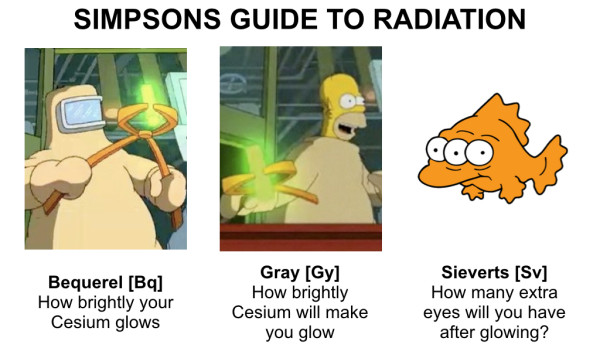
Becquerel[Bq] or Curie[Ci]: radiation emitted from a radioactive material (1 Ci = 3.7 × 10¹⁰ Bq)
Gray [Gy] or Rad[rad]: radiation absorbed by another material (1Gy = 100 rad)
Sieverts[Sv]* or “roentgen equivalent in man”[rem]: how badly radiation will damage biological tissue (1 Sv = 100 rem)
You can convert from Grays and Rads to Rem and Sieverts, but you have to know what kind of radiation it is. For example alpha radiation from naturally occurring Polonium-210 is more damaging to biological tissues than gamma radiation from Cesium-137. Even if you absorbed the same number of Grays from Cesium or Polonium, you would still effectively receive more damaging radiation from Polonium because the number of Sieverts is higher for Polonium than Cesium. And kids, Sieverts andSeavers are both dangerous to your health but please don’t confuse them.
WHAT’S CESIUM-137?
Cesium-137 is product of nuclear fission. Before us humans, there was no Cesium-137 on earth. But then we started blowing stuff up with nuclear bombs and VOILA!, there are now detectable, but safe, levels of Cesium-137 in all the world oceans.
WHAT DO THE MAPS OF FUKUSHIMA RADIATION IN THE PACIFIC REALLY TELL US?
There are a bunch of maps being thrown around on the internet as evidence that we are all going to die from Fukushima radiation. I’m going to dissect them here. Apologies in advance for dose of snark in this section because some of these claims are just god awful. Spoiler: radiation probably has reached the West Coast but it’s not dangerous.
MAP OF TERROR #1: The Rays of Radioactive Death!
[
source: https://www.enviroreporter.com/investigations/fukushima/a-radioactive-nightmare/]
This is not a map of Fukushima Radiation spreading across the Pacific. This is a map of the estimated maximum wave heights of the Japanese Tohuku Tsunami by modelers at NOAA. In fact, tsunamis don’t even transport particles horizontally in the deep ocean. So there is no way a Tsunami could even spread radiation (except maybe locally at scales of several miles as the wave breaks onshore). Dear VC reporter, I regret to inform you this cover image could be the poster child for the importance of journalistic fact-checking for years to come.
MAP OF TERROR #2: EHRMAGHAD radioactive SPAGHATTA NADLES attack Hawaii!
I mean I guess this is a bit better. At least this map used an ocean model that actually predicts where radioactive particles will be pushed around by surface ocean currents. But it still gets a BIG FAT FAIL.The engineering company that put this image/piece of crap out there couldn’t even be bothered to put a legend on the map. Their disclaimer says “THIS IS NOT A REPRESENTATION OF THE RADIOACTIVE PLUME CONCENTRATION.” Then what do the colors mean?
MAP OF TERROR #3: THE BLOB!
It’s true, oceanographic models have shown that radiation from Fukushima has probably already hit Aleutians and Hawaiian Island chain, and should reach the California Coast by Fall 2014 [Beherns et al. 2012]. The map above is showing the spread of Cesium-137 from the Fukushima reactor would look like right now, I mean radiation is apparently EVERYWHERE! But what is missing from most of the discussion of these maps is what the colors ACTUALLY mean.
We shall now seek guidance from the little box in the upper right hand corner of the map called the legend**. The colors showhow much less radioactive thethe decrease in the radioactiveconcentrations of Cesium-137 isotopeshave becomesince being emitted from Fukushima. For example, the red areas indicate the Fukushima Cesium-137 is now more than 10,000 times lessradioactiveconcentrated than when released. The California Coast, more than a million times less. The punchline is that overall concentrations of radioactive isotopes and therefore radioactivity in the Pacific will increase from Pre-Fukushima levels, but it will be way less than what was seen in coastal Japan and definitely not enough to be harmful elsewhere (we’ll get to more of that later).
** As Eve Rickert has thoughtfully pointed out, my description of the image is a little confusing. I’ve added corrections in blue to clarify.
HOW MUCH RADIATION WILL REACH THE WEST COAST?
Practically, what does ten thousand or a million times less radiation mean? It means that these models estimate the West Coast and the Aleutians will see radiation levels anywhere from 1-20 Bq/m3,while Hawaiian Islands could see up to 30 Bq/m3 [Beherns et al. 2012, Nakano et al. 2012, Rossi et al. 2013 ].
I could write a small novel explaining why the numbers differ between the models. For those that love the details, here’s a laundry list of those differences: the amount of radiation initially injected into the ocean, the length of time it took to inject the radiation (slowly seeping or one big dump), the physics embedded in the model, the background ocean state, the number of 20-count shrimp per square mile (Just kidding!), atmospheric forcing, inter-annual and multi-decadal variability and even whether atmospheric deposition was incorporated into the model.
Like I said before, the West Coast will probably not see more than 20 Bq/m3 of radiation. Compare these values to the map of background radiation of Cesium-137 in the ocean before Fukushima (from 1990). Radiation will increase in the Pacific, but it’s at most 10 times higher than previous levels, not thousands. Although looking at this map I would probably stop eating Baltic Herring fish oil pills and Black Sea Caviar (that radiation is from Chernobyl) before ending the consumption of fish from the Pacific Ocean.
[source: https://www.whoi.edu/page.do?pid=833...622&cid=94989]
WILL THE RADIATION REACHING THE WEST COAST BE DANGEROUS?
No it will not be dangerous. Even within 300 km of Fukushima, the additional radiation that was introduced by the Cesium-137 fallout is still well below the background radiation levels from naturally occurring radioisotopes. By the time those radioactive atoms make their way to the West Coast it will be even more diluted and therefore not dangerous at all.
It’s not even dangerous to swim off the coast of Fukushima. Buessler et al. figured out how much radiation damage you would get if you doggie paddled about Fukushima (Yes, science has given us radioactive models of human swimmers). It was less than 0.03% of the daily radiation an average Japanese resident receives. Tiny! Hell, the radiation was so small even immediately after the accident scientists did not wear any special equipment to handle the seawater samples (but they did wear detectors just in case). If you want danger, you’re better off licking the dial on an old-school glow in the dark watch.
CAN I EAT FISH FROM THE PACIFIC?
For the most part the answer is YES. Some fisheries in Japan are still closed because of radioactive contamination. Bottom fish are especially prone to contamination because the fallout collects on the seafloor where they live. Contaminated fish shouldn’t be making it to your grocery store, but I can’t guarantee that so if you are worried just eat fish from somewhere other than Japan.
Fish from the rest of the Pacific are safe. To say it mildly, most fish are kinda lazy. They really don’t travel that far so when you catch a Mahi Mahi off the coast of Hawaii its only going to be as contaminated as the water there, which isn’t very much.Hyperactive fish, such as tuna may be more radioactive than local lazy fish because they migrate so far. As Miriam pointed out in this post, there is a detectable increase of radiation in tuna because they were at one point closer to Fukushima, but the levels are not hazardous.
To alleviate fears that you may be glowing due to ingestion too many visits to your local sushi joint, Fischer et al. figured out exactly how much damaging radiation you would receive from eating a tower of tuna rolls. Seriously. Science is just that awesome. Supermarket tuna hunters would receive 0.9 μSv of radiation, while the outdoors subsistence tuna hunter would receive 4.7 μSv. These values are about the same or a little less than the amount a person receives from natural sources.
To put 0.9 μSv of radiation in perspective check out this awesome graph of radiation by xkcd. You’ll get the same amount of radiation by eating 9 bananas. Monkeys might be doomed, but you are not.
I EAT PACIFIC FISH AND SO CAN YOU!
I hope this list of facts has answered most of your questions and convinced you the Pacific and its inhabitants will not be fried by radiation from Fukushima. I certainly feel safe eating sustainable seafood from the Pacific and so should you. If you are still unsure, please feel free to ask questions in the comments section below.
continues at https://deepseanews.com/2013/11/true...hima-disaster/

-
 Bulletin Board
Quick Nav
Bulletin Board
Quick Nav

Click Banner For More Info
See All Sponsors
Advertise Here
Click anywhere but the link to dismiss overlay!
Results 1 to 6 of 6
-
geomancer

-
Real Name: (not displayed to guest users)
-
Join Date: Jun 17, 2005
-
Location: Sebastopol
- Expressed Gratitude: 718
- Received Gratitude 1,562 times for 647 posts
-
Last Online 01-19-2025
- View Profile
-
 Ignore
-
 View Posts: (1,027)
True facts about Ocean Radiation and the Fukushima Disaster

-
-
theindependenteye
-
Real Name: (not displayed to guest users)
-
Join Date: Jul 20, 2005
-
Location: Sebastopol
- Expressed Gratitude: 80
- Received Gratitude 1,064 times for 277 posts
-
Last Online 03-25-2024
- View Profile
-
Ignore
- Visit Homepage
-
View Posts: (636)
Re: True facts about Ocean Radiation and the Fukushima Disaster
I EAT PACIFIC FISH AND SO CAN YOU!
I hope this list of facts has answered most of your questions and convinced you the Pacific and its inhabitants will not be fried by radiation from Fukushima. I certainly feel safe eating sustainable seafood from the Pacific and so should you. If you are still unsure, please feel free to ask questions in the comments section below.
Richard -- do you really believe this, or do you offer it as an opposing perspective? -- Elizabeth
-
-
geomancer
-
Real Name: (not displayed to guest users)
-
Join Date: Jun 17, 2005
-
Location: Sebastopol
- Expressed Gratitude: 718
- Received Gratitude 1,562 times for 647 posts
-
Last Online 01-19-2025
- View Profile
-
Ignore
-
View Posts: (1,027)
Re: True facts about Ocean Radiation and the Fukushima Disaster
The article seems credible to me. That said, the only ocean fish I care to eat is wild salmon. Eating tuna is evil, as is anything obtained by trawling, long lines and the like.
Richard
-
-
sharingwisdom
-
Real Name: (not displayed to guest users)
-
Join Date: Jun 18, 2005
-
Location: Santa Rosa
- Expressed Gratitude: 2,354
- Received Gratitude 872 times for 354 posts
-
Last Online 02-06-2021
- View Profile
-
Ignore
- Visit Homepage
-
View Posts: (773)
Re: True facts about Ocean Radiation and the Fukushima Disaster
Northern California Beach Reading 500 CPM on 12/20/2013 - Fukushima Radiation Is Here! https://agreenroad.blogspot.com/2013/12/northern-california-beach-reading-500.html
The [ embedded] video was taken 12/20 with an Inspector Plus Geiger counter by 'Dave', giving readings on a Northern California beach due West of San Mateo. The beach is south of Princeton Harbor which in turn is just south of Pillar Point where 'Mavericks' big surf comes in. The best description is the San Mateo Coast. Just south again from Princeton Harbor begins the City of Half Moon Bay. Radiation readings have been taken here for two years, with everything showing normal background radiation levels. Now, all of a sudden, the radiation levels have jumped up.
More info listed at this site: https://www.enviroreporter.com/inves...ca-california/
 Posted in reply to the post by geomancer:

-
-
 kpage9
-
Real Name: (not displayed to guest users)
-
Join Date: Jan 10, 2008
-
Location: Boyes Hot Springs, northwest of Sonoma proper
- Expressed Gratitude: 450
- Received Gratitude 244 times for 102 posts
-
Last Online 01-13-2021
- View Profile
-
Ignore
- Visit Homepage
-
View Posts: (303)
Re: True facts about Ocean Radiation and the Fukushima Disaster
thanks so much for this richard! my favorite line:
MAP OF TERROR #2: EHRMAGHAD radioactive SPAGHATTA NADLES attack Hawaii!
-
-
Dogenzip
-
Real Name: (not displayed to guest users)
-
Join Date: Jul 26, 2011
- Expressed Gratitude: 74
- Received Gratitude 165 times for 40 posts
-
Last Online 02-08-2021
- View Profile
-
Ignore
-
View Posts: (65)
Re: True facts about Ocean Radiation and the Fukushima Disaster
There is much misinformation and also disagreement among 'experts' regarding the potential environmental and human health effects of Fukushima. The attached True Facts article minimizes the impacts of Fukushima. Who is funding this research ogranization? Have they accounted for the long term cumulative effects of the daily doses of Fukushima and other sources of man-made radiation?
I would suggest reading Enenews.com site which attributes all its sources of nuke related information with links. https://enenews.com/
Japan (Fukushima)
UN Official 'Astounded': Homeless are taken to work in Fukushima, ready to die -…
Gundersen: Nuclear fuel has been moved by groundwater at Fukushima Daiichi -- It…
Steam coming from Fukushima Unit 3 reactor building -- Observed multiple times t…
Epidemiologist back from Fukushima: "We're talking about a sacrifice zone and mi…
More from “Japan (Fukushima)”
US/Canada
Lead Researcher: Fukushima pollution may be causing sea star epidemic on West Co…
LA Times: Experts suggest bald eagle deaths are related to Fukushima radiation -…
Newspaper: Unprecedented declines in Alaska king salmon... related to impact fro…
'High Alert': Mystery illness killing bald eagles in Western U.S. -- Wings paral…
More from “US/Canada”
World
Post-Fukushima Report: Concern over Plutonium and Uranium being deposited and re…
Russian Experts: Fukushima pollution spreads all over Earth, clearly a large amo…
NY Post: Snow falling on Navy ship caused by Fukushima radioactive steam... "Is …
Conservative Radio Host: Fukushima could be going on for centuries -- Nobody kno…
More from “World”
Latest Headlines:
05:12 PM EST on December 30th, 2013 | 20 comments
Lead Researcher: Fukushima pollution may be causing sea star epidemic on West Coast — Sea urchins, sea cucumbers also affected — “Something’s making them susceptible”… “It’s unlike anything we’ve seen”… “Populations go locally extinct overnight, literally”
03:24 PM EST on December 30th, 2013 | 27 comments
LA Times: Experts suggest bald eagle deaths are related to Fukushima radiation — Idaho officials reporting similar sickness — “It’s hard to have your national bird in your arms, going through seizures” (AUDIO)
-


Gratitude expressed by 4 members:

Gratitude expressed by:
Gratitude expressed by:

Similar Threads
-
11 Facts About The Ongoing Fukushima Nuclear Holocaust
By arthunter in forum National & International PoliticsReplies: 0Last Post: 09-08-2013, 07:24 PM -
Fukushima Radiation in California has been hidden too
By Star Man in forum WaccoReaderReplies: 0Last Post: 05-26-2013, 08:26 PM -
Probe finds high radiation in damaged Fukushima reactor
By Hotspring 44 in forum WaccoReaderReplies: 0Last Post: 03-28-2012, 10:29 AM -
Radiation risks from Fukushima 'no longer negligible'
By daynurse in forum WaccoReaderReplies: 0Last Post: 04-12-2011, 12:55 PM -
Japan Faces Potential Nuclear Disaster as Radiation Levels Rise
By geomancer in forum WaccoReaderReplies: 3Last Post: 03-16-2011, 02:06 PM
Bookmarks
-
 Facebook
-
 Twitter
-
 StumbleUpon