

-
 Bulletin Board
Quick Nav
Bulletin Board
Quick Nav

Click Banner For More Info
See All Sponsors
Advertise Here
Click anywhere but the link to dismiss overlay!
Results 1 to 5 of 5
-
Founder & ModeratorBarry

-
Real Name: (not displayed to guest users)
-
Join Date: Apr 9, 2005
-
Location: Sebastopol, California, United States
- Expressed Gratitude: 9,590
- Received Gratitude 12,858 times for 4,051 posts
-
Last Online Today
- View Profile
-
 Ignore
-
 View Posts: (8,317)
-
-
 tomcat
-
Real Name: (not displayed to guest users)
-
Join Date: Jul 20, 2005
- Expressed Gratitude: 202
- Received Gratitude 244 times for 100 posts
- View Profile
-
Ignore
-
View Posts: (287)
-
-
tomcat
-
Real Name: (not displayed to guest users)
-
Join Date: Jul 20, 2005
- Expressed Gratitude: 202
- Received Gratitude 244 times for 100 posts
- View Profile
-
Ignore
-
View Posts: (287)
Re: Bill Moyers Video Essay on the Shutdown
Louis Brandeis
From Wikipedia, the free encyclopedia
Jump to: navigation, search
Louis Dembitz Brandeis (/ˈbrændaɪs/; November 13, 1856 – October 5, 1941) was an American lawyer and Associate Justice on the Supreme Court of the United States from 1916 to 1939.Louis Brandeis 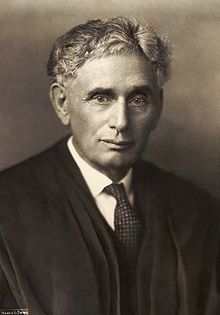
Brandeis in c. 1916 Associate Justice of the United States Supreme Court In office
June 1, 1916[1] – February 13, 1939Nominated by Woodrow Wilson Preceded by Joseph Rucker Lamar Succeeded by William O. Douglas Personal details Born Louis Dembitz Brandeis
November 13, 1856
Louisville, KentuckyDied October 5, 1941 (aged 84)
Washington, D.C.Spouse(s) Alice Goldmark (m. 1891) Alma mater Harvard Law School Religion Judaism
He was born in Louisville, Kentucky, to Jewish immigrant parents from Bohemia, who raised him in a secular home. He enrolled at Harvard Law School, graduating at the age of twenty with the highest grade average in the law school's history.
Brandeis settled in Boston where he became a recognized lawyer through his work on progressive social causes. Starting in 1890, he helped develop the "right to privacy" concept by writing a Harvard Law Review article of that title, and was thereby credited by legal scholar Roscoe Pound as having accomplished "nothing less than adding a chapter to our law". He later published a book titled Other People's Money And How the Bankers Use It, suggesting ways of curbing the power of large banks and money trusts, which partly explains why he later fought against powerful corporations, monopolies, public corruption, and mass consumerism, all of which he felt were detrimental to American values and culture. He also became active in the Zionist movement, seeing it as a solution to antisemitism in Europe and Russia, while at the same time being a way to "revive the Jewish spirit."
When his family’s finances became secure, he began devoting most of his time to public causes and was later dubbed the “People’s Lawyer.” He insisted on serving on cases without pay so that he would be free to address the wider issues involved. The Economist magazine calls him "A Robin Hood of the law." Among his notable early cases were actions fighting railroad monopolies; defending workplace and labor laws; helping create the Federal Reserve System; and presenting ideas for the new Federal Trade Commission (FTC). He achieved recognition by submitting a case brief, later called the "Brandeis Brief," which relied on expert testimony from people in other professions to support his case, thereby setting a new precedent in evidence presentation.
In 1916, President Woodrow Wilson nominated Brandeis to become a member of the Supreme Court. However, his nomination was bitterly contested, partly because, as Justice William O. Douglas wrote, "Brandeis was a militant crusader for social justice whoever his opponent might be. He was dangerous not only because of his brilliance, his arithmetic, his courage. He was dangerous because he was incorruptible. . . [and] the fears of the Establishment were greater because Brandeis was the first Jew to be named to the Court." He was eventually confirmed by the Senate by a vote of 47 to 22 on June 1, 1916,—21 Republican Senators and one Democratic Senator (Francis G. Newlands of Nevada) voted against his nomination—and became one of the most famous and influential figures ever to serve on the high court. His opinions were, according to legal scholars, some of the "greatest defenses" of freedom of speech and the right to privacy ever written by a member of the Supreme Court.
 Posted in reply to the post by tomcat:

-
-
dzerach
-
Real Name: (not displayed to guest users)
-
Join Date: Sep 3, 2011
- Expressed Gratitude: 98
- Received Gratitude 193 times for 101 posts
-
Last Online 10-26-2019
- View Profile
-
Ignore
-
View Posts: (130)
Re: Bill Moyers Video Essay on the Shutdown
Look at how happy they were signing the Medicare Modernization Act of 2003. Someone will be making a lot of money -- why, they're completely giddy! oh yay money money money for me! The scam called Medicare Part D (a federal program to subsidize the costs of prescription drugs for Medicare beneficiaries in the United States) was enacted as part of the Medicare Modernization Act of 2003 (MMA) and went into effect on January 1, 2006
"These guys here - these guys!! -- it's always the same, it's always more!"
The Tru-Coat scene from the movie Fargo -
https://www.youtube.com/watch?v=E5gwc4UizUc
Posted in reply to the post by Barry:
-
-
 arthunter
-
Real Name: (not displayed to guest users)
-
Join Date: Jun 1, 2006
-
Location: Sebastopol
- Expressed Gratitude: 872
- Received Gratitude 1,345 times for 821 posts
-
Last Online 02-06-2021
- View Profile
-
Ignore
-
View Posts: (1,923)
Re: Bill Moyers Video Essay on the Shutdown
This seems excessive ...
https://www.theminorityreportblog.co...mes-lake-mead/
-
 Top
Top

Gratitude expressed by 2 members:


Similar Threads
-
Bill Moyers Essay: When We Kill Without Caring
By arthunter in forum National & International PoliticsReplies: 3Last Post: 08-21-2013, 10:16 AM -
Bill Moyers Essay: Newt's Obsession with Saul Alinsky
By Barry in forum National & International PoliticsReplies: 1Last Post: 02-09-2012, 12:33 AM -
Bill Moyers on Haiti
By zenekar in forum WaccoReaderReplies: 0Last Post: 01-24-2010, 02:34 PM -
wonderful video--playing for change & Bill Moyers
By kpage9 in forum General CommunityReplies: 1Last Post: 12-10-2008, 11:30 PM -
wonderful video--playing for change & Bill Moyers
By kpage9 in forum WaccoReaderReplies: 1Last Post: 12-10-2008, 11:30 PM
Bookmarks
-
 Facebook
-
 Twitter
-
 StumbleUpon