Amendment XXVIII,
Section Four,
Explained:
Quote:
[SECTION 4.] The U.S. Congress does also hereby authorize the U.S. Treasury to recall, by eminent domain, all outstanding U.S. Treasury Securities, constituting the “National Debt,” and to Convert them by Fiat, into a new species of dollar-denominated, and non-interest-bearing credit instrument, to be termed "National Credit Receipts." All U.S Securities owned by individual persons shall be redeemed, at face value, in credit, on the books of the Common-Wealth Central Bank. However; all outstanding U.S. Treasury Securities originally purchased from the Federal Open Market Committee by Banking Corporations at Treasury bond-auctions, shall be discounted to seven percent of their “value” and be accounted as balances on the Books, and by the Credit, of the Common-Wealth Central Bank of the United States of America.
In the first place, you must understand that the so-called "National Debt" is denominated
in interest-bearing U.S. Treasury Securities; i.e., 'Bonds.' As I wrote, in the Apologia,
Quote:
https://waccobb.net/forums/images/misc/quote_icon.png iolchan wrote: https://waccobb.net/forums/images/bu...post-right.png
Amendment XXVIII Re-Asserts the Constitutional principle that Congress – the Representatives of We, the People - should control, and be the ultimate Arbiter over the Creation of Money and Credit.
Amendment XXVIII Nationalizes the private ownership of the Federal Reserve Bank, and subsumes the creative functions of that institution into the Treasury Department, creating a Sub-Treasury “Common-Wealth Central Bank” - to be established and dedicated to the Interest of the People – not Wall Street.
Amendment XXVIII Authorizes Congress to recall the National Debt, and transforms, by Congressional Fiat, the fraudulent “National Debt,” held by prime banks in the form of U.S. Treasury Securities, into an actual National Blessing in the form of billions and billions of Dollars of “Common-Wealth” to be deposited in the New “Common-Wealth, Central Bank” by recalling, and transforming the U.S. Treasury Bonds, by Fiat, into a new, non-interest-bearing, dollar-denominated credit instrument: the “National Credit-Receipt.”
Amendment XXVIII cleans out the Augean Stables of the Treasury Department and the Federal Reserve Bank, and opens the Books, Documents, and Records of those Institutions to the minutest Public Scrutiny. Amendment XXVIII also asserts “…there shall be no further issues of Treasury Securities, or Bonds.”
The point is, as Thomas Edison said, "If“
our nation can issue a dollar bond, it can
issue a dollar bill. The element that makes the bond good makes the bill good."
You see, it can be done by Fiat - by a Congressional Fiat, no less.
This bonded indebtedness of the U.S. Federal Government, may be
recalled and then transformed, by Fiat - in the name of the People;
All of the People; into a new instrument - a National Credit Receipt,
as good as dollars on the market; in fact, just another form of "Dollar."
Understand?
That, indeed, would be a Divine Fiat, and a proper expression
of the Divinity that is inherent within Humanity...
For it was GOD who said > in Hebrew, not Latin < : "Fiat Lux"
- or -
" Let there be Light."
...and there was Light.
Quote:
https://waccobb.net/forums/images/misc/quote_icon.png iolchan wrote: https://waccobb.net/forums/images/bu...post-right.png
An elegant solution, Amendment XVIII, ...Nationalizes the National Debt; and transforms the Treasury Department into a Treasury of Common-wealth; and fills the coffers of this new institution with billions and billions of "dollars" of Credit & establishes a new specie of credit-instrument; a dollar-denominated "National Credit Receipt" to be just as serviceable as “Dollars” on the international market.
Amendment XVIII makes a distinction between the U.S. Savings Bonds that were purchased by Ma and Pa bond investors and those U.S. Treasury Securities that were purchased by the Prime Banks at Bond Auctions held under the auspices of the Federal Open Market Committee, the Federal Reserve’s Window on Wall Street. Commercial Banks have always utilized the “multiplier” of the fractional reserve system to purchase U.S. Treasury Securities at cents on the dollar.
In recognition of this Fact - that such transactions are, and have always been, from the beginning, Fraudulent - AMENDMENT XVIII renders the outstanding “Debt” that is “owed” to the Prime Banks of this – and every other Nation - at a mere 7% [Seven per cent] of the face value of such Fraudulent, Banker-secured paper “Debt.”
This reduction of the Debt to a Sum that is payable in Credit, on the Books of the new Sub- Treasury Central Bank-of-Issue, the “Common-Wealth Central Bank” is, in Reality, exceedingly fair and Just, in recognition of the Fraud that has been committed by the Community of International bankers, in foisting the former system upon the unsuspecting Public.
Paying off that portion of the U.S.Government National Debt that is owed to the International Commercial Banks and their stockholders, in "Cash" at seven cents on the dollar, is exceeding fair and just, because, as I wrote, in The Problem with the Federal Reserve :
Quote:
:
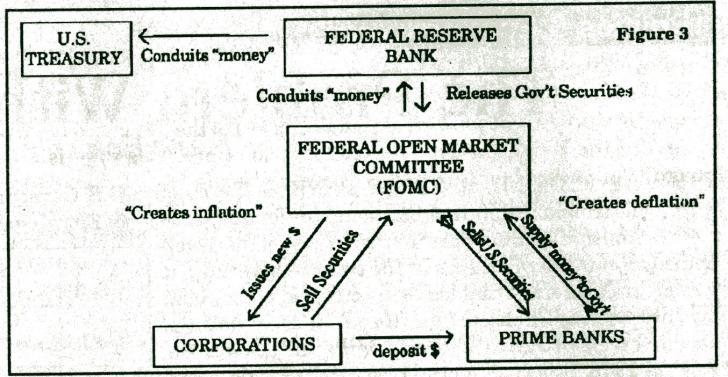
Figure 3 is a picture of the Fed's relationship with the Federal Open Market Committee (the FOMC), the Fed's window upon Wall Street, the creation of which was part of the marvelous "Reform" package of that Father Christmas and friend of the people, Franklin D. Roosevelt. The FOMC, in order to "regulate" the economy, buys and sells on the open market corporate and government bonds and securities. This is so it can create inflation when that is needed or deflation, should that be necessary. It creates "inflation" by buying corporate securities from both domestic and foreign corporations. It pays for the securities by issuing "new money," that is, money it has created out of thin air, as is its privilege.
The Fed operates on the principle that corporations need the money and that it eventually will find its way into the economy. Thus we find the New Deal was practicing "trickle-down" economics long before Reagan. In buying government bonds the commercial banks use the "Fractional Reserve" currency they are allowed to create. The corporations, which are favored with Federal Open Market Committee largesse, as a rule, have inter-locking directorates with the commercial banks, where they park their money.
These banks can then multiply their deposits by the factor determined by the current reserve ratio and purchase government bonds, speculate, or lend to customers. The Fed, meanwhile, when economic conditions dictate, pontificates solemnly that there is too much inflation and that they must put the brakes on the economy and institute a little deflation. The Fed, so the story goes, causes "deflation" by selling bonds and securities on the open market. The theory has it that the FOMC sells bonds, to take money out of the economy because "too much money" in the economy has caused "inflation," which in turn has caused prices to rise, and that's bad. That's the cover story.
When prices rise, it's generally not because of scarcity of commodities - or because the volume of money has made prices "dear." - It's usually because the cartels have simply jacked the prices up a notch. [This is no longer the case with regards to oil.]
Profit. The real reason the Fed sells bonds through the FOMC is because the business of the Fed is transfer wealth and energy (money rendered back in taxes is the tangible expression of labor and energy) from the people to the bond-holding class.
The term "bond-holding class" does not refer to the Ma & Pa owners of "U.S. Savings Bonds," but to the elite families who own the "preferred" stock in the Prime Banks, and utilize the ability of these banks to create "Fractional Reserve" dollars out of thin air. These Families receive Quarterly dividends from this bank-stock. The Fed sells U.S. government securities (the notes that were issued against the money in square 1) in order to raise money for the poor government, which is continually running into deficit, spending beyond its allocated budget.
These securities, as long as they remained in the vaults of the Fed, were the property of the people. But the Fed is continually moving these bonds, through bond auctions at the FOMC, into the "public," (that is, the banking) sector. You will remember that the prime banks are able to multiply their deposits to create new money. These prime banks and foreign, and domestic brokerage houses, queue up to buy government bonds when they are offered for sale.
This is merely one more way our hungry government obtains money. The "new" bank-created money is transferred from the "reserve accounts" of the prime banks at the Fed and is credited to the Government. The prime banks, however, have acquired interest-bearing bonds.
You see, the bond-holding class, unlike the Ma and Pa owners of U.S. Savings bonds, utilize banks and Bankers as their front-men. Thus, they have acquired, by means of the "fractional reserve" system, the bulk of the National Debt, at cents on the dollar. Therefore, they should only be paid cents on the dollar in return. They have already looted the economy, and sucked like leaches upon the body politic long enough.
I call this the "7 % Solution" =OR= "THE SEVEN PER CENT SOLUTION" Period. Can I find a Production Company? My thinking on these points is directly influenced by the populist economic ideology of the old Farmer-Labor Party, and is informed by the book, "Banking, Currency, and the Money Trust," by the elder Lindbergh, who, after being excommunicated from the Republican Party in 1917, became a co-founder, and the chief economic theoretician of the Farmer-Labor Party, of Minnesota.
The Farmer-Labor Platform of 1934 declared :
Quote:
- Nationalization Of Banking With Government
Monopoly of Money And Credit operated without profit.
The large chain banks have worked a hardship on the small business man. Government control of money and credit will assure the average business man fair treatment. At the present time, he is being discriminated against and is at the mercy of greedy and selfish interests...
All money should be directly issued by the government and made full tender in payment of all debts... and should be put in circulation by the payment of all government bonds due, or soon to become due, and in payment for all public works construction there shall be no further issue of interest bearing bonds.
The issue of money is a governmental function and all money should be issued directly by the government and made a legal tender in payment of all debts.
The issuance of interest-bearing bonds is in essence the issuance of money, since it represents a government guarantee to pay. In effect, it means the people are paying interest on their own money.
Sincerely,
Mark Walter Evans