NYT:Is "Peak Oil" Behind Us?
Is ‘Peak Oil’ Behind Us?
https://green.blogs.nytimes.com/2010...er=rss&emc=rss
By JOHN COLLINS RUDOLF https://graphics8.nytimes.com/images...k-blogSpan.jpg
International Energy Agency Projections of the world’s liquid energy sources to 2035.
Peak oil is not just here — it’s behind us already.
That’s the conclusion of the International Energy Agency, the Paris-based organization that provides energy analysis to 28 industrialized nations. According to a projection in the agency’s latest annual report, released last week, production of conventional crude oil — the black liquid stuff that rigs pump out of the ground — probably topped out for good in 2006, at about 70 million barrels per day. Production from currently producing oil fields will drop sharply in coming decades, the report suggests.
The agency does not see energy doom on the horizon, however. By its estimation, after a short dip in production, crude production will reach an “undulating plateau” of about 68 million barrels per day between 2020 and 2035.
Yet strong demand growth from China, which the report estimates is now the world’s largest energy user, and elsewhere will require liquid energy supplies to not just hold steady, but to climb by more than 20 percent.
Meeting that additional demand will fall entirely on unconventional oil sources like Canada’s tar sands as well as increased production of natural gas liquids. A major boost in these energy sources should be able to meet demand, but that is far from certain, Nobuo Tanaka, the agency’s executive director, told reporters in London, according to the Associated Press.
“Recent events have cast a veil of uncertainty over our energy future,” Mr. Tanaka said.
The I.E.A.’s stance that 2006 will be the year global supplies of conventional oil reached their ultimate peak is a more pessimistic take than its previous assessments. In 2008, the organization projected that conventional oil production would continue to slowly climb for several more decades.
Its current estimate that enough new oil will be found to keep the oil supply roughly steady for the next 25 years is hardly ironclad, however, a point the report acknowledges in the executive summary. “Will peak oil be a guest or the spectre at the feast?” its authors ask.
“The size of ultimately recoverable resources of both conventional and unconventional oil is a major source of uncertainty for the long-term outlook for world oil production,” it concludes.
Over all, oil prices should continue to climb in coming decades, reaching $135 per barrel by 2035, a price level that some economists believe contributed to the global economic collapse of 2008.
Some experts found the report’s projections troubling.
“It’s a perfect storm headed our way — a steady rise in global demand for oil crashing up against an increasingly limited supply of economically recoverable oil,” William Chameides, professor of environmental science at Duke University, wrote on his blog.
2 Attachment(s)
Re: NYT:Is "Peak Oil" Behind Us?
Thanks for posting this, Barry. This new IEA report has encouraged the Peak Oil community in that perhaps people might actually start taking this issue seriously, especially now that MSM like the NY Times, which has almost always poo-poo'ed the idea of Peak Oil in the near future, is finally taking notice and not just dismissing it as a "fringe" issue.
What's almost funny is that in all other years, including last year, the IEA has always refused to acknowledge that Peak Oil might even be a possibility in the near future. It's a classic example of how ideas evolve to become accepted - from first being totally ignored to becoming self-evident. With the IEA in one nanosecond it went from a fringe topic that wasn't even worthy of discussion, to being common knowledge and a done deal, with no steps in between.
One thing particularly striking about this report is how it projects the amount "oil yet to be found" that's needed to meet the projected demand for the next 25 years. This report assumes a rate of new oil discovery at a rate way higher than the current rate of discovery. At the current rate of discovery it would take 90 years to "find" all this new oil, not 25 years. That's a lot of confidence in a radical increase in the rate of new oil discovery. And that's just to keep up.
Below I posted some additional commentary on the IEA report from theoildrum.com for any Peak Oil geeks out there, although I'm sure the geekiest of Peak Oil geeks (you know who you are) have already read this as well.
Scott
IEA World Energy Outlook 2010: Questionable Assumptions and Major Omissions
Posted by Gail the Actuary on November 13, 2010 - 10:55am
The World Energy Outlook 2010 makes quite a number of assumptions that seem wrong, and omits important ideas. Here are a few that Oil Drum staff members have mentioned. You may have others you think should be added to the list.
1. Net Energy. The WEO assumes all energy resources are equal, without considering "Net Energy" or "Energy Return on Energy Invested." Society needs a certain level of energy to maintain its current state of development. The resources we are talking about using now are of lower and lower net energy (oil sands, oil shale, arctic oil, very deep oil, coal-to-liquids; also many of the "renewables"). It is not at all clear that all of the resources being examined in the WEO are really of value in solving our energy problems.
2. Quality of Energy. One cannot simply substitute one type of energy for another. Even if we have a temporary surplus of natural gas, the vast majority of our cars cannot run on natural gas. Ethanol can be substituted for a small share of the gasoline in today's cars (10% for cars made prior to 2007 and 15% for those made since then), but if the amount of gasoline declines, so will the amount of ethanol that can be used for substitution--this is a major reason that work today is being done on "drop-in" fuels. Electricity is not substitutable for liquid fuels, without major changes in the machines now using liquid fuels--for example, a semi-truck or bulldozer will generally not run on electricity, and of course electricity does nothing to replace the many non-fuel uses for oil such as medicines, synthetic fabrics, herbicides and pesticides. Variable electricity, such as from wind and solar PV, reduces the fuel needed for electric generation, but it is not otherwise a replacement for fossil fuels.
If one wishes to have substitutability across qualities of energy, there are long term changes that can be undertaken to make this happen (for example, replace cars of one type with another type), but such changes are neither quick nor cheap.
3. Recession from High Prices (Low Net Energy). If we try to use lower and lower quality energy resources, prices can be expected to rise higher, because low net energy and high cost pretty much go hand in hand. There are strong indications that oil above $85 a barrel (in 2009$) sends the US economy into recession. (See this post by Dave Murphy. Others have come to a similar conclusion.) The recessionary impact may be the signal that the amount of net energy that the economy is receiving is too low. The IEA assumes that OECD economies can continue to grow, regardless of oil price or of alternative energy price, even though this is very questionable.
4. OPEC Politicized Reserves. Many of the countries that the WEO is hoping to obtain increased oil production from between now and 2035 are countries that have very politicized reserves.
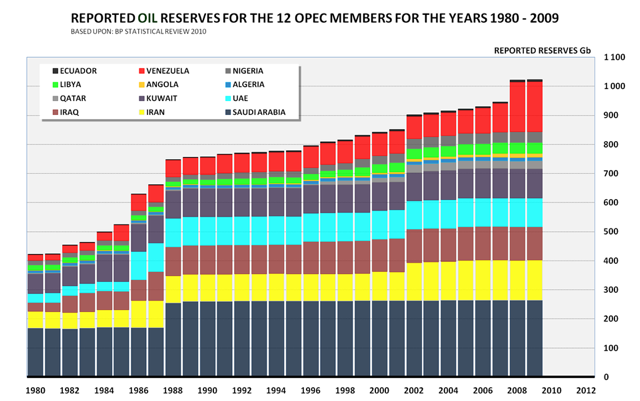
Graph showing historical oil reserves by Rune Likvern.
Back in the early years of development, reserves were set by International Oil Companies, including some from the US, doing work in these countries. But after National Oil Companies took over, upward reserve "adjustments" were made by a number of OPEC countries, in moves that seems to be designed to help with getting increased OPEC quotas, or to elevate the countries in the eyes of their citizens and of people around the world. Very recently, there have been additional upward adjustments, which seem also to be political in nature. None of these amounts are audited.
It is possible that if we had 10,000 years for extraction, and could afford oil that sells for $500 a barrel, these countries might have the amount of oil claimed. But no one has reviewed how many resources can legitimately be claimed as reserves, in a reasonable time frame, at a cost that economies can afford to pay.
5. Questionable USGS Reserves. USGS published its last major set of reserve estimates in 2000, but it is not clear that these estimates are very useful in determining how much is actually extractable at prices economies can afford to pay. There are also questions as to whether there have been major mistakes in estimates. Just last week, the USGS announced that most of the oil resources it was expecting in the National Petroleum Reserve in Alaska were in fact, natural gas resources. (Natural gas reserves in this location are of little economic value, because the natural gas is too far away from markets--yet another low "net energy" issue.) How do we know that other resources (for example, the supposed resources in the Arctic National Wildlife Refuge), are not as badly mis-estimated?
6. Omission of Export Analyses. Oil exports available to importers have been declining for five years now. Oil use by oil exporters rises each year, since populations of these countries are growing, and since leaders want to keep their citizens happy. The oil available to oil importers is only what is left, after oil exporters have taken what they see as necessary for their own needs. WEO does not look at this issue. (See this post.)
7. Overly Rosy View of Unconventional Natural Gas. Production of shale gas is currently high and prices are low. The question is whether this is a temporary market aberration (to be followed by bankruptcies and reduced production) or something one can count on as a major offset for future natural gas shortages. The Oil Drum has published articles such as this one by Art Berman, and this one by myself, Gail Tverberg, suggesting that production costs are much higher than current market prices.
High costs here again are no doubt related to low net energy return. The typical Wall Street view is that prices can rise as much as needed to get the natural gas, but as with oil, this assumption may prove to be wrong. If natural gas prices rise very high, the result may simply be worse recession. This result could mean that extraction is taking more energy than the gas itself is producing--especially if one takes a broader view of required energy, including required infrastructure such as roads. So if the energy return of unconventional gas is too low, it may have to be left in the ground.
8. Failure to address why world oil production has been flat for six years. If the amount of available oil reserves is so great, why hasn't new oil been rushed into production in the last six years, as oil prices spiraled to $147 barrel? If there was difficulty raising production in the last six years, how can one possibly assume in the "Current Policies" scenario that oil production would continue to rise in the future.
One of the issues in the recent flat production is the flow rate of reserves. Some of the unconventional oil is extremely slow to extract. Reserves to production ratios can be extremely misleading, because the fact reserves are there, doesn't mean a reasonable amount can be extracted in a given year. It is a little like having a bank account with $5 billion dollars, that you can only remove $100 a year from.
9. Assumption that smart grid will be of more benefit than it will be. Great hopes are placed in the smart grid, but if use an approach that gets electricity from more renewable energy, our fluctuations in electricity availability will be more seasonal (spring and summer when rains greatest for hydroelectric; local seasonal variations for wind; summer vs winter for solar). A smart grid will do nothing to solve this issue. (See this post.) Having each electric company send out time of day and time of week rates, the way telephone companies did years ago (Call on Sunday when rates are low!) would seem to accomplish much of the same objective, at a lower cost.
10. Assumption that major improvements in energy intensity of GDP can be expected in the future. In the past, improvements in energy intensity of GDP have been observed for a variety of reasons--shift in the nature of the economy to one more focused on services; ability to substitute modern energy-efficient cars, appliances, power generating units for less efficient ones; and building of more energy efficient buildings, for example. WEO 2010 assumes huge continued improvements in energy intensity, particularly oil energy intensity:
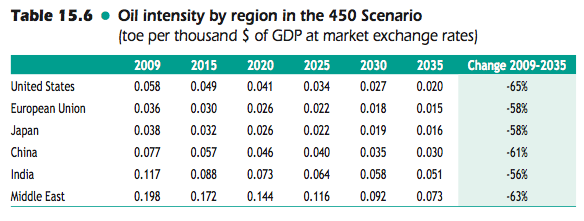
Perhaps some improvement in energy intensity of GDP can be made, but I wonder whether we are kidding ourselves about the extent of the possible improvement. As energy availability reduces, the shift toward a service economy may very well reduce. This could especially be the case, if certain types of imports become too expensive relative to locally produced goods, and it is necessary to shift production back more to OECD countries. Also, it takes energy to make new cars, appliances, and power generating stations, and to build new energy-efficient buildings. If energy is more scarce, replacing these is likely to take place at a slower rate than in the past, not at a faster pace. Some proposed activities like carbon sequestration and coal to liquids would seem to act in the opposite direction of lower energy intensity of GDP. At a minimum, this issue needs to be examined more closely.
11. Failure to consider constraints other than oil. There are many limiting factors, other than oil. Water is already a problem in many parts of the US and in much of the rest of the world. Lack of availability of water may be a problem if carbon capture and storage is considered, or if new fossil fuel or nuclear generating capacity is added for other reasons. Minerals ores are becoming more and more depleted, and some, such as those for rare earth minerals and lithium, are available in only a few places on earth. Maintaining or increasing production will take an increasing portion of what oil is available. Biofuels are clearly limited by the amount of arable land available to plant them, and by their impacts on soil depletion. Normally, the soil is enhanced each year by the recycling of organic matter to it. If this is removed, soil quality can be expected to degrade.
12. Failure to put together all of the costs. Under any scenario there will be huge costs involved. For example, if we use a scenario with a significant amount of wind power, there will need to be an expensive networks put into place, with an upgraded grid, electrical storage, and fossil fuel backup generation. Carbon capture and storage applied to coal would require greatly increased coal mining, new railroads for all of the coal, greater fresh water use, and would reduce energy efficiency. Without putting all of the costs together, it is hard to see what is feasible and what is not.
One of the big concerns when considering all of the costs is the capital needed to finance all of these improvements. At this point, major governments are spending far more than they are taking in in taxes. All of the enhancements that are planned through government spending will need to be considered in addition to collecting current revenue shortfalls. The total costs may well put a cap on what can realistically be done.
Re: NYT:Is "Peak Oil" Behind Us?
Tricky, misleading headline. It seems to say the problem is over, or, if you're hip to the argument, the problem has arrived. Slippery!
Thanks for the additional info Scott. I'm no wonk, more of a generalist, so the list was a reminder of the devils in the details. Links in the text are scrubbed but I know I can go to the website to pick them up.
So, what have we learned? We're royally screwed! But that wasn't news to me, or anyone else paying attention. Wonk or not.